How Data Analytics and AI Are Shapingthe Future of Football Match Analysis
A couple of years ago I sat in a press box at the Etihad and watched Manchester City’s coaching staff pass around an iPad between substitutions. On the screen: a live dashboard showing pressing intensity, passing networks, and something called “off-ball movement heat maps” for both teams. This wasn’t a beta product or a research experiment. This was a Premier League matchday. The data was feeding directly into decisions that affected the outcome of a game millions of people were watching. And yet most of those millions had absolutely no idea it was happening.
That’s the thing about football analytics right now. The revolution isn’t coming—it’s already happened. But it’s happening behind closed doors, in analysis rooms and on tablets that cameras never show. The average fan, and even the average bettor, is still making decisions based on information that’s already two generations behind what top clubs and the sharpest betting operations are using. If you want to understand where football analysis is heading—and where the real edges in betting are hiding—you need to understand what’s changed and what hasn’t.
The Three Eras of Football Analysis
It helps to think about this in phases. The first era was the chalkboard era. For about a hundred years, football analysis meant a manager drawing formations on a tactical board and relying on subjective assessment. Scouts watched players with their eyes and wrote reports. Training sessions were designed around intuition and tradition. Some of the greatest managers in history—Shankly, Clough, Rinus Michels—worked entirely within this framework and won everything there was to win. But the information gap between clubs was enormous, and most decisions were made on gut feel.
The second era started in the mid-2000s when companies like Opta (now part of Stats Perform) and Prozone began tracking every touch, pass, tackle, and movement in professional matches. Suddenly, clubs had access to data that told them things their eyes couldn’t. How far did a player run? What percentage of passes were forward? How many times did the team recover the ball in the final third? This was revolutionary at the time, and clubs that adopted these tools early—Arsenal under Wenger, Liverpool under Rodgers’s early tenure, later Brentford and Midtjylland—gained genuine competitive advantages.
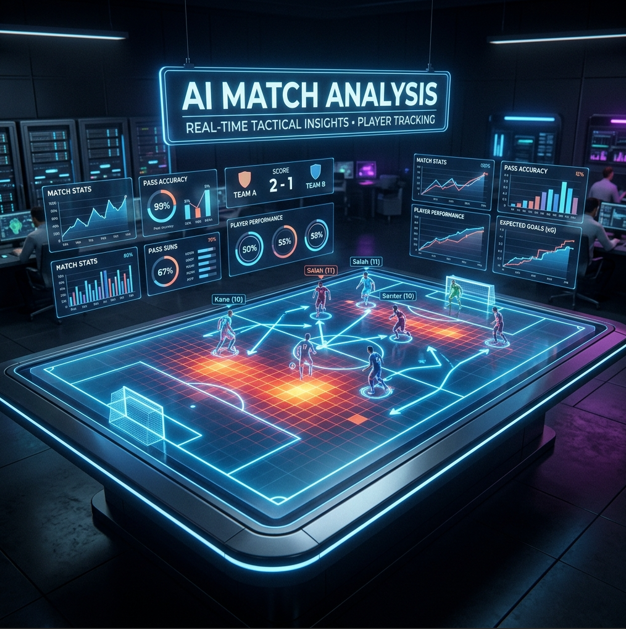
We’re now in the third era, and it’s defined by two things: the sheer volume of available data, and the computational power to make sense of it. Modern player tracking systems generate millions of data points per match. Every player’s position is recorded 25 times per second. Add to that GPS data from training, biometric data from wearables, and event data from matches, and you’re looking at datasets that no human can process unaided. This is where AI enters the picture—not as a replacement for human judgment, but as a tool that makes human judgment better informed.
What an AI Match Analyst Actually Does
The term “AI match analyst” sounds futuristic, but the reality is more grounded than most people imagine. An AI match analyst—whether that’s a person using AI tools or an automated system—is essentially doing three things that were either impossible or extremely time-consuming five years ago.
Pattern Recognition at Scale
Human analysts can watch maybe 3 to 5 full matches per day and produce detailed reports. That’s a hard physical and cognitive limit. An AI system can process hundreds of matches in the same time, identifying patterns that would take a human analyst weeks to notice. Here’s a concrete example: an AI system might identify that a particular team concedes a disproportionately high number of goals between minutes 60 and 75 when their defensive midfielder has covered more than 11 kilometers. A human analyst might eventually notice this trend. The AI spots it in minutes, across a sample of 200 matches, with statistical confidence.
This kind of pattern recognition is especially valuable for identifying opponent weaknesses. Before a match, coaching staff can receive an automated briefing that highlights, for instance, that the opposing left-back struggles when pressed high and that the opposing goalkeeper has a significant weakness distributing to his right side. These aren’t vague observations—they’re backed by data from dozens of matches and quantified with specific probabilities.
Predictive Modeling for Match Outcomes
This is where things get interesting for anyone who follows football betting. AI models trained on historical match data, player tracking data, and contextual variables (injuries, weather, travel distance, rest days) can produce match outcome probabilities that rival or exceed what traditional scouts and analysts generate. The key advantage of these models isn’t that they’re always right—they’re not. It’s that they’re consistent, they process more information than any human can, and they don’t get emotionally attached to narratives like “this team always wins at home” or “this player is due for a goal.”
Several Premier League clubs now use proprietary AI models to evaluate transfer targets. Instead of relying on highlight reels and scout reports, they feed performance data into models that project how a player would fit into their tactical system, what their expected output would be, and how their performance is likely to evolve over the next three years. The models aren’t perfect—football has too many unquantifiable variables for that—but they provide a structured analytical baseline that human scouts can then adjust based on things the data can’t capture, like a player’s personality, work ethic, or ability to handle pressure.
Real-Time In-Match Analysis
Perhaps the most impactful application is happening during matches. Modern AI systems can process live tracking data and provide coaching staff with real-time insights. Is the opposing team’s pressing intensity dropping? The system can detect that before any human notices. Is a specific player’s sprint frequency declining, suggesting fatigue? The data flags it. Are the opposition making more passes into a particular zone than usual, indicating a tactical adjustment? The model picks it up within minutes.
This is what I saw on that iPad at the Etihad. It’s not a replacement for a manager’s tactical intuition—it’s an enhancement. Guardiola sees something on the pitch and has a hunch about a substitution. The data on the tablet either confirms that hunch or suggests it might not work. Sometimes Guardiola ignores the data. Sometimes he doesn’t. But the point is, he has it available. Most managers at the top level now do. And the gap between managers who use this information and managers who don’t is growing wider every season.
What the Data Actually Shows (And What It Doesn’t)
Let me be specific about what current football analytics can and cannot do, because the gap between public perception and reality is large.
What the data is good at: identifying underlying performance trends that results don’t always reflect. A team that’s lost three consecutive matches but has maintained strong xG numbers and defensive metrics is probably experiencing bad luck, not a collapse. A striker who hasn’t scored in six games but is consistently getting into high-quality shooting positions is likely due for a correction. These are the kinds of insights that traditional analysis misses and that data-driven approaches catch.
What the data struggles with: capturing the qualitative aspects of football that everyone who has ever played or coached the game knows matter enormously. Team chemistry, dressing room dynamics, a player’s confidence level, the psychological impact of playing in front of a hostile crowd—these are real, match-altering factors that current data models handle poorly or not at all. A team with perfect underlying metrics but internal locker room problems will underperform those metrics, and no algorithm currently exists that can reliably quantify that underperformance in advance.
The smartest people in football analytics are the ones who are upfront about these limitations. They don’t pretend the data tells you everything. They treat it as one input among several, and they weigh it appropriately based on the specific context. A model might say Team A has a 62% chance of winning. An experienced analyst who knows that Team A’s star player is going through a divorce and the team’s captain just had a public argument with the manager might adjust that probability down to 55%. The model provides the foundation. Human judgment provides the adjustment. That’s how this works in practice, at the highest levels.
How This Changes Football Betting
If you’re reading this and you’re someone who bets on football, you should already be connecting the dots. The same data and AI tools that are transforming how clubs prepare for matches are available—in varying degrees—to anyone willing to put in the work. The question is: does access to this information actually give you an edge over the bookmaker?
The answer is complicated. The bookmakers themselves are using AI models to set their odds, so the starting point isn’t your intuition versus a human oddsmaker—it’s your analysis (AI-assisted or otherwise) versus the bookmaker’s analysis (also AI-assisted). The edge doesn’t come from having access to data, because everyone has access to data now. The edge comes from interpreting it differently, from seeing something in the data that the bookmaker’s model didn’t weight properly, or from combining the data with contextual knowledge that the model can’t access.
Here’s a practical example. An AI model might project that a team’s expected goals output will decline significantly because their key creative midfielder is injured and his replacement has much lower progressive passing numbers. If the bookmaker’s model hasn’t fully incorporated the injury’s impact on the team’s attacking patterns—perhaps because the injury was only confirmed 24 hours before the match—the odds on the underdog might be slightly inflated. A bettor who catches this discrepancy has found value.
This isn’t theoretical. People are doing this right now. The most successful football bettors in the world operate more like data analysts than traditional gamblers. They build or subscribe to prediction models, they track team news obsessively, and they look for specific situations where their information is better, faster, or differently interpreted than the bookmaker’s. Platforms like eg1x.bet aggregate odds from multiple bookmakers, which is a necessary first step—you can’t find value without knowing what the market is pricing.
The Tools That Matter Right Now
If you’re interested in getting deeper into football data analysis, there are several publicly available tools and data sources worth knowing about, even if you never build a model yourself.
For raw data, FBref (part of the StatsBomb ecosystem) is the best free resource available. It provides detailed stats for dozens of leagues and competitions, including xG, xA (expected assists), progressive carries, defensive actions, and more. The interface is clean, the data is reliable, and you can export it into spreadsheets for your own analysis. If you’re not using FBref or a similar resource before placing bets, you’re operating at a disadvantage.
For more advanced analysis, StatsBomb offers detailed event data (freeze frames, pressure maps, pass height and angle) that goes well beyond what free platforms provide. Their data is used by professional clubs and betting syndicates, and it’s available through subscription. It’s overkill for casual bettors but essential for anyone serious about building analytical models.
Understat focuses specifically on xG data for the major European leagues and does it well. Their visualizations are intuitive, and their season-by-season xG tables are useful for identifying teams that are significantly over- or under-performing their underlying numbers. Wyscout is another professional-grade platform that provides scouting-level data on players across the world, and while it’s primarily aimed at clubs rather than bettors, serious betting analysts use it extensively.
The point isn’t that you need all of these tools. It’s that they exist, they’re accessible, and the people making money from football betting are using them. Even spending 20 minutes on FBref before placing a weekend accumulator gives you more information than most casual punters have when they pick their bets based on team names and recent results.
Why the Best Managers Still Ignore the Data Sometimes
And they do. Regularly. Jurgen Klopp has publicly talked about moments where the data suggested one thing and his gut told him another—and he went with his gut. Carlo Ancelotti famously uses data sparingly, preferring to manage through relationships and intuition. Diego Simeone has won La Liga and reached multiple Champions League finals with a tactical approach that data enthusiasts would describe as deeply suboptimal.
These aren’t anti-data Luddites. They’re experienced professionals who understand that football is played by human beings, not spreadsheets. A player might have perfect underlying numbers but be going through personal problems that make him ineffective. A tactical system might look statistically superior on paper but fail because the players available don’t have the technical ability to execute it. A team might have dominant possession stats but be playing against an opponent whose defensive structure specifically neutralizes the kind of possession-based football they play.
The data tells you what has happened and what is statistically likely to happen. It doesn’t tell you what will happen, because football stubbornly refuses to be fully quantified. Every analyst, whether they work for a football club or a betting syndicate, has a story about a time the data pointed one way and the match went the other, often for reasons that no model could have anticipated. A red card in the third minute. A goalkeeper injury. A controversial VAR decision. These are the moments that make football both maddening and beautiful, and no amount of data or AI is going to change that.
What’s changing isn’t the nature of football. It’s the depth of understanding available to people who are willing to look beyond the scoreboard. An AI match analyst—whether that’s a professional at a club or an informed bettor with a laptop and a spreadsheet—isn’t trying to replace football. They’re trying to see it more clearly. And in a sport where the difference between winning and losing can come down to a single moment of quality, seeing even slightly more clearly than your opponent is worth everything.