Motorcycle Wreckers Australia for Quality Bike Parts
Motorcycle wreckers can help you source used components, but no single wrecker’s stock represents all of Australia. If you need a replacement for a repair, or have an unwanted motorcycle, prepare its make, model, year and your location. Those details help start a clear enquiry.
An OEM part is a component made to the motorcycle manufacturer’s original equipment specification. A used component may suit your needs, but stock and service arrangements differ between businesses. Confirm availability, collection options and any quote directly with the business. Registration details may also help when you ask about an unwanted bike.
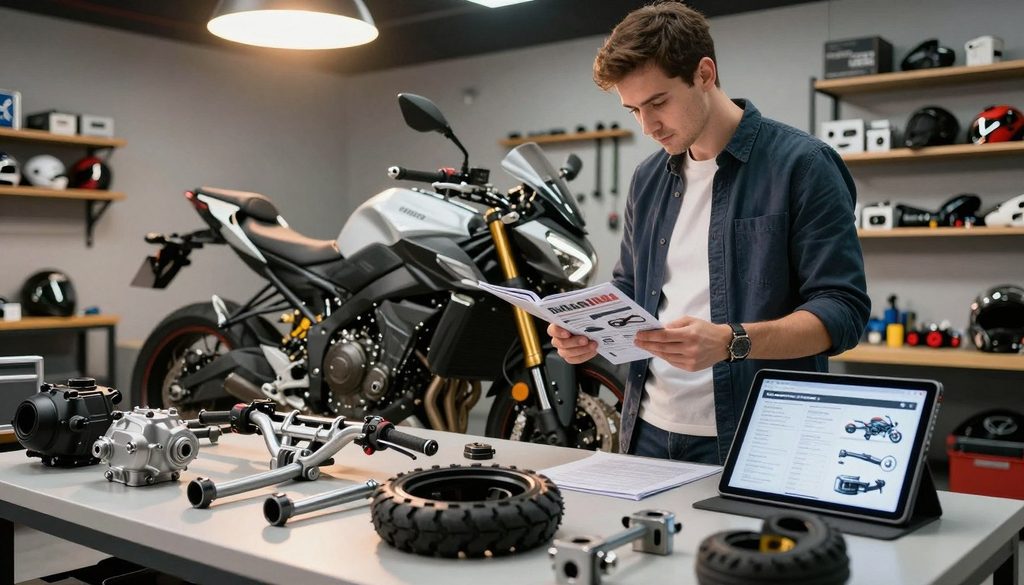
This page explains how motorcycle wreckers obtain reusable components and how you can make a useful enquiry. You will need to describe the exact motorcycle or part, then confirm any details that affect the next step. Start by understanding what wreckers do and how they obtain reusable components.
Key Takeaways
- Prepare your motorcycle’s make, model, year and location before asking about a part.
- Check exact fitment, condition and included hardware before ordering.
- Confirm current stock and any quote with the individual business.
- Ask directly about delivery or collection before making plans.
- Send clear photos when a component or motorcycle needs identification.
What Do Motorcycle Wreckers Do?
Parts offered by motorcycle wreckers come from motorcycles dismantled for component recovery. Motorcycle wrecking means taking donor motorcycles apart and separating components that may suit reuse.
Stock depends on the donor bikes a business has dismantled, so one inventory cannot show national availability. A wrecker may assess an unwanted motorcycle, remove suitable components and offer those used motorcycle parts for sale. An OEM part follows the motorcycle maker’s original equipment specification, while a used motorcycle part has already been in service.
Stock depends on dismantled donor bikes. A listing or location cannot confirm that a specific part is available.
Availability can change as motorcycles arrive and components sell. This means the same business may have a part one day and not later. A quote applies to the specific part and the details provided, not every motorcycle with a similar name.
Searching for “motorcycle wreckers near me” may help you find businesses to contact for a local enquiry. Proximity alone does not confirm stock, shipping, collection or service in your area. Ask what the business can arrange for your location.
Some businesses focus on dismantling motorcycles, while others also sell used components or assess unwanted bikes. Their services and stock vary. A local listing is a starting point, not proof that a nearby business holds what you need.
Once you know how components enter stock, you can narrow an enquiry to the kind of motorcycle parts needed for your repair or restoration.
What Motorcycle Parts Can You Source?
If a motorcycle needs one damaged fork replaced, you may only need that component rather than a complete bike. Parts enquiries can cover many systems, but the examples below do not promise current stock.
A complete assembly and one small component may need different identification details. An engine assembly, for example, is not the same enquiry as a starter or a fuel-system fitting. State whether you need a whole unit or an individual piece.
Engines, fuel systems and electrical components
Engine parts may include a complete engine, cylinder head or other internal component. Fuel-system enquiries can involve a fuel tank, pump or related fitting. Electrical components may include a starter, switch, wiring section or other item tied to the motorcycle’s design.
For dirt bikes and road motorcycles, describe the exact component rather than asking only for “engine parts”. A starter can look close to another version yet use a different connector. Clear wording helps the business understand what you mean.
Suspension, wheels, brakes and bodywork
Suspension parts can include a fork or shock. A wheel, brake component, handlebar control or fairing may also be offered as a used motorcycle part. Some bodywork and model-specific hardware can be hard to describe without a photo.
Use these five enquiry categories to organise what you need:
- Engine and fuel
- Electrical
- Suspension and wheels
- Brakes and controls
- Bodywork and model-specific hardware
Categories are only a starting point, not a promise of stock. Before treating a listing as a match, check the exact motorcycle model and part identity.
How Can You Check Fitment Before Buying?
Two motorcycles can share a model name but use different fittings in another production year or variant. Fitment checks help you tell whether the listed component suits your motorcycle.
A shared make or similar model name does not prove that a part will fit. Compare the exact variant, part number and listing details before ordering. Use the table to gather useful information.
Match the motorcycle’s make, model and year
Start with the make, model and year shown in the owner’s manual or on the motorcycle’s records. Model variants can use different parts, even when the name looks almost the same. If you have the VIN, share it when the seller requests it.
| Check | Where to find it | What to compare | Why it matters |
| Make, model and year | Manual or records | Exact listing details | Names and years can hide changes |
| Variant or VIN | Frame or records | Variant code or VIN details | Variants may use different fittings |
| Part number | Old component or manual | Number on listed component | Numbers can identify a specific version |
| Photos of connectors or mounting points | Original part and listing | Shape, position and number of points | Similar parts may attach differently |
Compare part numbers, photos and mounting points
A part number can help distinguish versions that share a model name. Compare it with the number on your original component, if it remains readable. Check photos for the same connectors and mounting points.
When identification is uncertain, send clear photos of the original part, including its label, plugs and fixing points. Ask about any detail that remains unclear rather than relying on a broad model name. After confirming a likely match, examine the condition and contents of the individual listing.
What Should You Check About a Part’s Condition?
A listing may name a component but leave its mounting points out of view. Clear condition details matter because a photo of the main face cannot show every area that affects use.
Do not assume an unclear description means the component is undamaged. Review the part number, stated condition, photographs and all items included. Compare the images with your original part, including edges and attachment points.
Look for visible wear, cracks, dents, corrosion, damaged threads or signs of previous repair. A photo can reveal some issues, but it may not show every fault. Ask for more detail if the description does not explain an area that matters.
Check whether the listing includes the hardware or accessories you need. A mirror may be shown without its fixing bolt, while a brake component may be offered without related fittings. Confirm what is included before comparing the part with your repair needs.
Ask whether the photographs show the actual component being offered. Some listings may use a general image, so do not treat a picture alone as proof of the item’s current condition. The reply should clarify what the listing covers.
Once you understand the listing, compare the different ways to source a replacement component.
Which Ways Can You Source a Motorcycle Part?
You may be choosing between a used replacement, a new part or a component offered by a private seller. Each route has different stock and condition details to check.
A motorcycle wrecker may suit a used-component enquiry, but the route does not guarantee availability. A new-parts retailer and a private seller offer different choices and information. An online listing can remain visible after its item has sold.
| Route | Source of part | Condition information to request | Fitment check |
| Motorcycle wrecker | Component from a dismantled motorcycle | Ask about wear, damage and included items | Compare the exact model and part number |
| New-parts retailer | New replacement component | Confirm whether it is new and complete | Check the maker’s listed model and year |
| Private seller | Individual seller’s item | Ask how it was used and inspect its photos | Compare the number and mounting details |
Buying from a motorcycle wrecker
A motorcycle wrecker dismantles donor motorcycles and may offer recovered components for reuse. Ask for information about the specific item rather than assuming all stock follows one standard. Its availability can change as components sell.
Considering new parts or a private seller
A new replacement part may offer a different condition and warranty arrangement from a used component. Check the retailer’s terms and confirm that the exact version suits your motorcycle. A private seller may know the item’s history, but details can vary.
Choose the route that fits your needs and the information you can confirm. The next comparison should focus on the quote for the specific used part.
What Affects the Price of a Used Motorcycle Part?
A used part’s quote depends on the specific component and its condition. The individual details matter more than a general rate for all motorcycle parts.
There is no single quote that applies to every seller or part. The table shows details that can shape a quote and what to include in your enquiry.
| Factor | How it can affect the quote | Useful detail to provide |
| Component type and completeness | A full assembly differs from one small component | Name the part and included hardware |
| Condition | Wear or damage can affect its value | Describe the known condition |
| Model or variant | Specific versions may differ in demand | Give exact make, model and year |
| Current availability or demand | Stock changes as parts sell or arrive | Identify the exact item you want |
When comparing quotes, check that each covers the same component and included hardware. A quote for an engine assembly is not a fair comparison with one for a single engine component.
A clear description helps the seller understand the item you mean. Include a part number or a photo when possible, and ask whether the quoted amount covers the item alone or other items too.
Once you have identified the part and its quote details, choose a suitable local or Australia-wide enquiry route.
How Can You Find Motorcycle Wreckers Across Australia?
You may need a part but feel unsure whether local collection or delivery is practical. Your suburb or postcode helps a business respond to a location-specific enquiry.
A local listing does not prove that a business offers pickup, has a counter nearby or holds parts in your area. Motorcycle wreckers near Sydney, NSW and motorcycle wreckers in Melbourne or Victoria are location-based searches, not guarantees of service.
Use these three steps to make the enquiry more useful:
- Identify the nearest relevant business you can contact.
- Say whether you are asking about stock or delivery.
- Confirm collection or freight directly before making plans.
A business may sell motorcycle parts beyond its immediate area without offering local pickup everywhere. Some enquiries may be handled by phone or online, with transport arranged separately. Ask which options apply to your location.
Include your postcode when you ask about delivery or collection. The business can then tell you whether your request is practical and what details it needs. Do not assume a nearby search result means the part is nearby too.
With a suitable enquiry route in mind, check the business’s current stock and item information before placing an order.
What Should You Confirm Before Buying From a Wrecker?
A listing may look right for your motorcycle, but the item may already have sold. Current confirmation helps you avoid acting on old stock information.
Parts availability changes as donor motorcycles are dismantled and components sell. Confirm the exact item, its current condition and included parts before you commit. A broad brand or model category does not prove the exact variant is held.
Check the current listing and included items
Ask whether the part is still available and whether the photographs show the actual item. Confirm its stated condition, included items and any fitment evidence. Ask about order terms that apply to your purchase.
Do not treat a category such as “road model parts” as evidence that a specific variant is in stock. Provide the exact year and component name. A part from a similar model may not match your motorcycle.
Ask about the enquiry in your area
Motorcycle wreckers in Brisbane and motorcycle wreckers in Adelaide are location-specific enquiries. Motorcycle wreckers across Australia is broader still, but none of these searches confirms stock or delivery to your address.
State your location and ask whether the business can handle your order there. Check any collection or freight terms before paying. Availability and service arrangements can differ between businesses and individual parts.
When those details are clear, you can consider how motorcycle wrecking and recycling handle a donor motorcycle after an enquiry.
How Does Motorcycle Wrecking and Recycling Work?
Dismantling separates potential reusable components from other materials. The process can recover some motorcycle parts while directing remaining material to suitable recycling.
Not every part of a dismantled motorcycle is necessarily reusable. A component’s condition helps determine whether it may suit reuse. The general process has three stages:
- Assessment of the motorcycle and its components.
- Recovery of components considered suitable for reuse.
- Handling of remaining materials for appropriate recycling.
During assessment, the motorcycle and its parts can be reviewed for recovery. A reusable component is removed and kept separate from material that is not suitable for that purpose. The exact approach depends on the individual motorcycle and parts.
Motorcycle dismantling does not mean every component becomes a used motorcycle part. Damage, wear or missing pieces may make an item unsuitable for reuse. Remaining materials can be directed to appropriate recycling.
Businesses may handle motorcycles and materials in different ways. This general sequence explains where some used components come from without making claims about a specific operator’s environmental or safety practices.
If you have a motorcycle that is no longer useful to you, consider what information an enquiry about it should include.
Can You Sell a Damaged or Unwanted Motorcycle?
If a damaged motorcycle no longer makes sense to repair, you can ask whether it may suit an assessment. Running status is only one detail that can help describe the bike.
A non-running or incomplete motorcycle can still be submitted for assessment, but an enquiry does not guarantee an offer. An assessment may consider its make, model, year, condition, completeness and location.
Describe whether the bike runs, what damage you can see and whether any parts are missing. Include its registration status and location. Clear photos of the whole motorcycle and damaged areas can help explain its condition.
Collection options and any offer depend on the individual motorcycle and access to it. A bike stored behind a locked gate or in a hard-to-reach space may need a different arrangement from one parked beside a road.
Enquiries can concern running, damaged, incomplete or non-running motorcycles. Explain the situation plainly rather than assuming a particular type will be accepted. A business can decide whether it can assess that bike.
Useful details make it easier to assess either a parts request or an unwanted motorcycle, so prepare the right information before asking for a quote.
How Do You Request a Useful Quote?
A useful quote request starts by identifying exactly what you need assessed. Separate the request into a parts enquiry or a motorcycle assessment, since each needs different details.
Give the exact motorcycle and a clear description of the part or bike. The right details vary between a request for one component and an assessment of a whole motorcycle.
Gather these five details before sending either enquiry:
- Make
- Model
- Year
- Condition or part description
- Location
Preparing a parts enquiry
For a part, include the exact make, model, year and component needed. Add the part number or VIN if available. Clear photos of the original part, connectors and mounting points can help identify it.
Say whether you need a complete assembly or one component. Point out any detail you are unsure about, such as a worn-off part number. Ask for the quote and current availability for that specific item.
Preparing a motorcycle assessment
For an unwanted motorcycle, describe its condition, running status, completeness and location. Include clear photos of the whole bike and any visible damage. Registration status can also help describe the motorcycle.
Keep the two enquiry types separate, even if you are asking about both. One request concerns a component; the other concerns the motorcycle itself. Move next to specialist enquiries for dirt, trail and enduro motorcycles.
Can You Find Parts for Dirt and Enduro Motorcycles?
A rider needing a model-specific dirt bike component should name the exact bike and part. Off-road enquiries still depend on the motorcycle’s model, year and component details.
A part from a similar dirt bike model may not fit your motorcycle. Enquiries can cover dirt bikes, enduro motorcycles, motocross bikes and road motorcycles, but that does not mean a particular part is in stock.
State the exact model and year, then name the component you need. For example, you might ask about a suspension part, engine component, fuel-system part or control. These are enquiry examples, not a list of available stock.
Off-road models can have changes between versions that are easy to miss. A similar frame shape or model name does not establish fitment. Share the part number or clear photos when you have them.
Include whether the motorcycle is a dirt bike, enduro or motocross model. That context can help narrow the enquiry, while the exact version and component remain important. Avoid assuming one part suits several related models.
Once a possible match is identified, confirm how the part can reach you or whether collection is available.
What Should You Confirm About Shipping or Collection?
You may have found a suitable part but still need to decide how it will reach you. Transport arrangements depend on the seller and the item.
Do not travel to collect a part before the seller confirms the arrangement. A delivery quote may need your postcode and item details, while collection timing should be agreed directly.
Getting a delivery quote
Give the seller your postcode and the details of the item. Ask whether its size, weight or handling needs affect transport. Confirm the estimated timing and any cost before paying.
Arranging collection
Ask whether collection is offered and what time suits the seller. Confirm the address, item readiness and any access needs before setting out. Collection is not available from every seller or location.
| Option | What to confirm | Useful detail |
| Carrier freight | Whether offered, timing and cost | Postcode, item size and handling needs |
| Collection by arrangement | Address, time and item readiness | Your available collection time |
| Local delivery if the seller offers it | Coverage, timing and any cost | Delivery postcode and preferred timing |
Do not assume that a business offers shipping, local delivery or collection. Ask which arrangements apply to your part and location. Check the cost and timing as part of the order discussion.
Once the transport terms are clear, a few final checks can help prevent a poor used-part purchase.
How Can You Avoid Common Used-Part Buying Mistakes?
A replacement may look right while its mounting point remains hidden or unverified. Check the details before buying and fitting a component.
Safety-critical components such as brakes and suspension need careful condition and compatibility checks. Ask a qualified mechanic for help if you cannot assess them yourself.
Watch for these four common mistakes:
- Ordering by model name alone: compare the exact variant and part details.
- Overlooking damaged mounting points: inspect clear photos or ask about hidden areas.
- Failing to confirm included hardware: check which bolts, fittings or accessories come with it.
- Replacing a part before diagnosing the fault: confirm that the component caused the problem.
A worn component can resemble a fault elsewhere in the system. Replacing the wrong part may leave the repair unfinished and add avoidable cost. If the cause is unclear, get help with diagnosis before ordering.
Inspect the part’s condition and confirm the points that affect your repair. For brakes and suspension, a qualified mechanic can assess concerns that photos cannot settle.
If you are ready to make an enquiry, send the exact details and ask the seller what remains unclear.
What Is the Next Step When You Have Found a Part?
Confirm the exact part and its current availability before arranging payment. A clear enquiry lets the seller respond to the motorcycle and component you actually need.
An online listing is not enough to order when fitment or current availability remains unclear. Send the exact motorcycle and part details, then ask about any fitment or condition question you still have.
Confirm the exact part and its current availability before arranging payment. An online listing alone does not settle fitment or stock.
Ask for the quote and confirm the delivery or collection terms. If a detail is uncertain, such as the included hardware or a connector shape, raise it before ordering.
If you are not sure what caused the fault, diagnosis before buying may help you avoid choosing an unnecessary component. A replacement part cannot fix a problem elsewhere on the motorcycle.
Keep the enquiry focused on the exact component, fitment and arrangement you need. A precise enquiry is the best starting point for finding out whether the part suits your repair.
Conclusion
Accurate motorcycle details make parts enquiries more useful. Exact model and part information can help with fitment checks, while current availability and transport still need direct confirmation.
Prepare the make, model, year, part description and clear photos before contacting a motorcycle wrecker. These details can help the business understand your request, but they do not guarantee stock or a particular service in your location.
Send those details and ask for confirmation of the part, quote and delivery or collection arrangements.
FAQ
Can I ask for photos before buying a used motorcycle part?
Yes, you can ask for clear photos before buying, though photo availability depends on the seller. Request views of wear, connectors, mounting points and any included hardware. Those areas can show details a single front-facing image may miss. Ask whether the images show the actual part being offered, especially if the listing uses a general product photo.
How can I tell if a motorcycle part fits a different model year?
A shared model name is not enough to confirm fitment across model years. Compare the exact variant, part number and mounting points with your original component. Production changes can affect connectors or fittings, even when two motorcycles look alike. If the part number is unclear, send photos of the original and listed part, then ask about the difference.
Do motorcycle wreckers sell parts for discontinued motorcycles?
They may have parts for discontinued motorcycles, but availability depends on donor bikes and current stock. Provide the exact year and component before assuming a part can be sourced. A broad model category does not confirm that a particular variant is held. Ask whether the specific item is available, and whether the listing shows the actual component.
Can I return a used motorcycle part if it does not fit?
Return terms differ by seller, so a return is not guaranteed if a part does not fit. Confirm the applicable terms before ordering, especially when fitment has not been independently verified. Share the motorcycle’s exact variant and part number when possible. Ask how the seller handles a mismatch and whether any time limits or conditions apply.
What details should I provide to get a quote for my damaged bike?
Give the make, model, year, running status, condition, completeness, location and clear photos. Describe visible damage and note whether parts are missing. Registration status may also help explain the bike. These details support an individual assessment, but an enquiry does not guarantee an offer or a collection arrangement.
How long does delivery of used motorcycle parts take?
Delivery timing depends on dispatch arrangements, the carrier and your destination. Ask for an estimate using your delivery postcode before placing an order. Confirm when the part may be sent and whether the estimate includes any handling time. Timing can differ between sellers and items, so do not rely on a general estimate from another listing.